
Ta Nea (English)
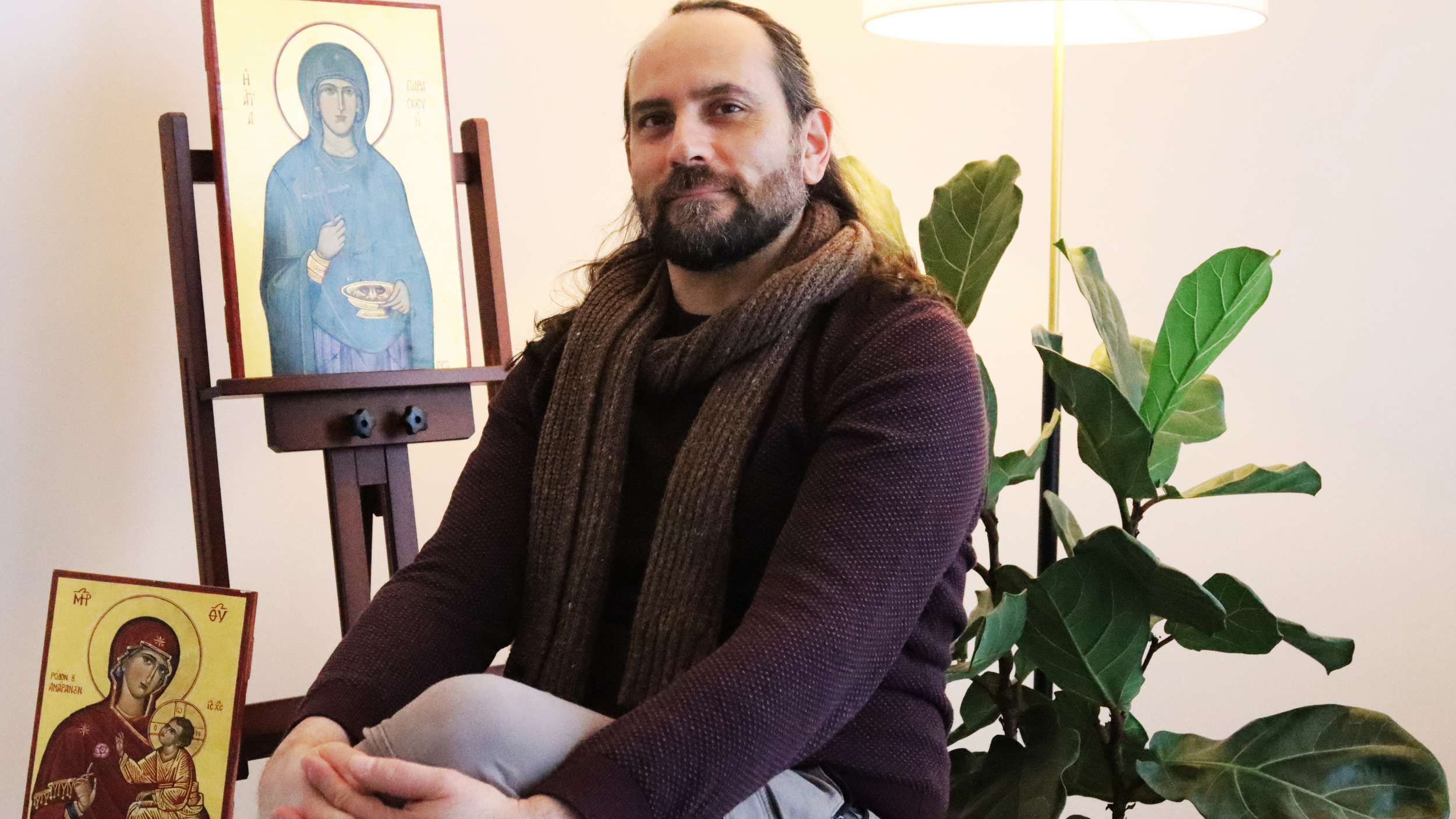
Apostolos Lagoutatzis brings Byzantine iconography to new audiences
24 September, 2026
Apostolos Lagoutatzis and the art of Byzantine iconography: artist collaborates with Melbourne’s Hellenic Museum to bring a sacred Orthodox tradition to new audiences
● Melbourne-based artist Apostolos Lagoutatzis to deliver Writing the Divine, an 8-week Byzantine iconography course for beginners at the Hellenic Museum, Melbourne CBD
● Apostolos is the founder of Ikon Atelier, with over 15 years’ experience in iconography
● Course designed to run alongside the Hellenic Museum’s new major exhibition, Divine Thresholds: Icons and the Orthodox Christian World, now showing until late August 2027
● Writing the Divine 8-week course commences 10 October 2026. For more information and links, please see the ‘Event Details’ section of this release.
Melbourne, 16 September 2026 – Meet Apostolos Lagoutatzis, the Melbourne-based artist who is breathing new life into a sacred Orthodox tradition at Melbourne’s Hellenic Museum.
For more than fifteen years, Apostolos has devoted himself to the art of Byzantine iconography, writing icons for churches, communities and private collections throughout Australia and abroad, alongside founding his own studio, Ikon Atelier.
His journey has been one of both practice and formation, shaped by the guidance of clergy and hierarchs in the Orthodox church, and accompanied by a growing engagement with the theology, sacred music and visual language of the Byzantine tradition.
Now, that journey enters a new chapter as he prepares to pass on this living tradition at the Hellenic Museum, with Writing the Divine: An Introduction to Byzantine Iconography.
This eight-week course has been developed by Apostolos in collaboration with the Hellenic Museum, in connection to the Museum’s new Divine Thresholds: Icons and the Orthodox Christian World exhibition, and has been designed to introduce complete beginners to the sacred art and tradition of Byzantine iconography.
A tradition received – Apostolos’ iconic journey
Long before he considered teaching iconography, Apostolos was quietly writing icons for Orthodox parishes across Australia and abroad.
Among his early ecclesiastical commissions was an icon for the Church of the Transfiguration of Our Lord in Thomastown, commissioned by the then Father Evmenios, now a bishop of the Greek Orthodox Archdiocese of Australia.
Another commission followed for the historic Annunciation of Our Lady (Evangelismos) in East Melbourne, commissioned by Archimandrite, Father Kosmas Damianides.
As Apostolos began receiving commissions from parishes, he was conscious that the work he was undertaking belonged to something greater than an individual artistic practice.
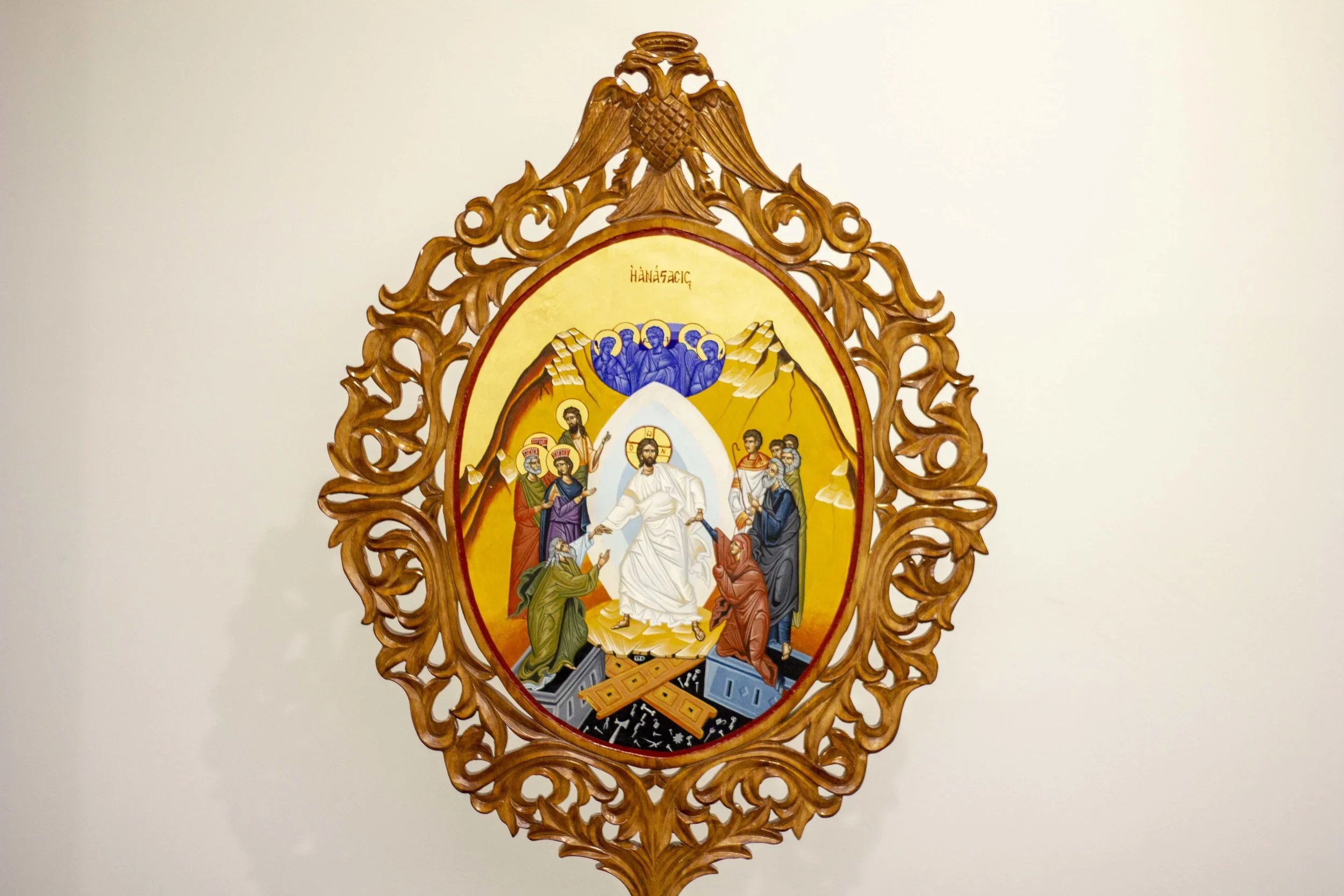
Icon commissioned for the Church of the Transfiguration of Our Lord Thomastown 2018
He immediately sought the blessing of
the Church to undertake his work as an iconographer, receiving the blessing of His Eminence Metropolitan Ezekiel of Dervis, together with Bishop Iakovos of Miletoupolis,
who became an important mentor to Apostolos during his development as an iconographer.
That relationship between tradition, blessing
and transmission has remained central to the way Apostolos understands his work.
“That blessing has always been important to me. I understand iconography not simply as an artistic practice, but as a sacred tradition that belongs within the life and theology of the Orthodox Church,” Apostolos explains.
Byzantine iconography is a sacred visual language, formed within the theology and worship of the Orthodox Church and carefully handed down from one generation to the next.
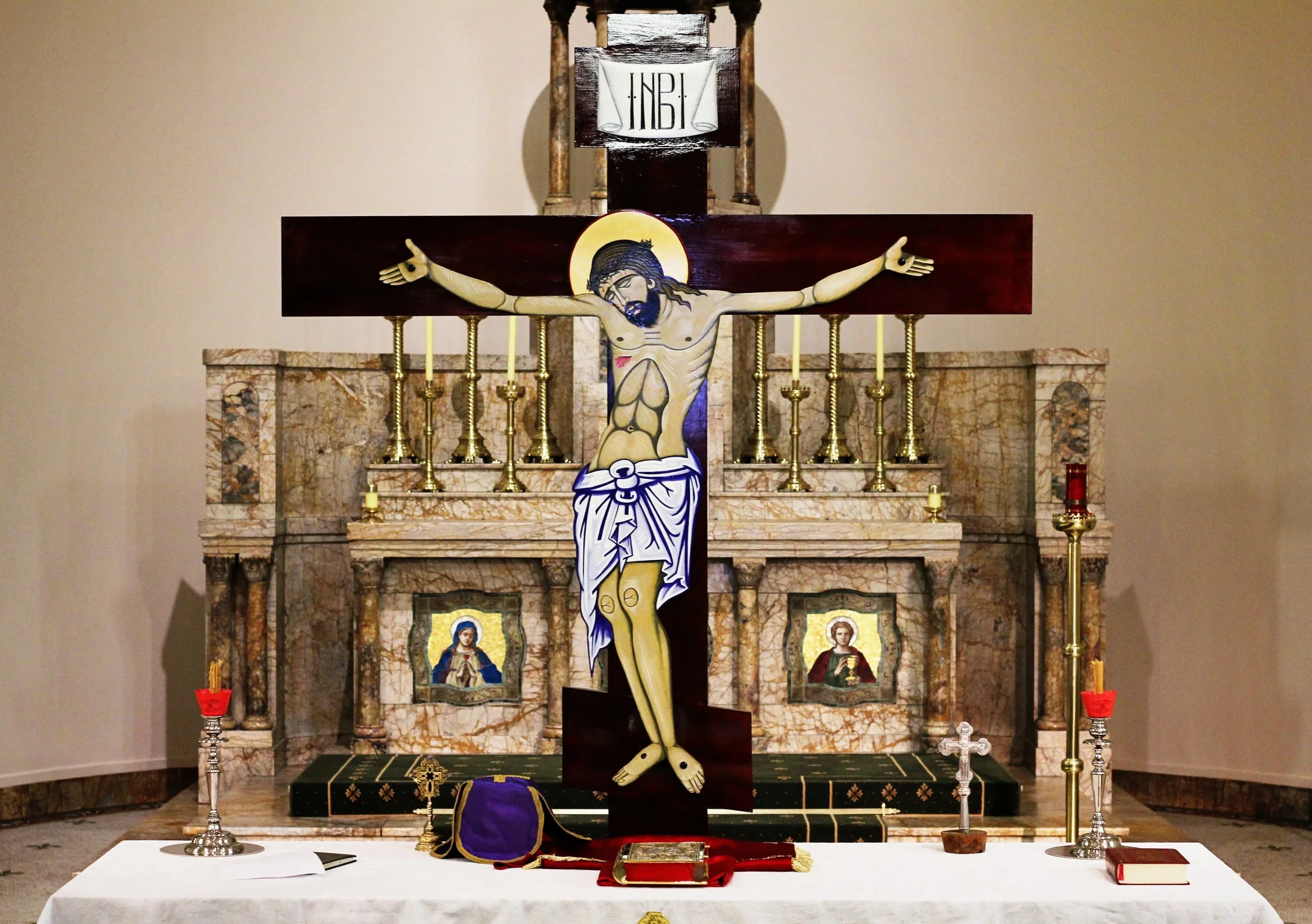
Icon commissioned for Evangelismos East Melbourne 2020
From sacred image to sacred music – expanding into other Byzantine traditions
In 2015, another dimension of that tradition began to unfold when Apostolos commenced learning Byzantine sacred music at St Eustathios Church in South Melbourne, under the tuition of Lambro
Vlahandonis.
Although one artform is expressed through image and the other through sound, Byzantine iconography and Byzantine sacred music share something fundamental.
Both are inherited languages.
Neither asks the practitioner simply to invent. Each requires the student first to listen, observe and learn – to receive a tradition preserved across generations before, in time, becoming capable of passing it on.
Apostolos continued that process of formation and completed theological studies at St Andrew’s Greek Orthodox Theological College in Sydney, deepening the theological foundations that have always accompanied his iconographic practice.
A long-standing relationship
with the Hellenic Museum
It is through his study of Byzantine sacred music that Apostolos’ relationship with the Hellenic Museum was born.
The connection began with Between East and West, a Byzantine music concert hosted by Apostolos’ wife at the Hellenic Museum in April 2023. The event brought the musical tradition of Byzantium into the Museum, creating an early connection that would, in time, grow to encompass both sacred music and sacred image.
That relationship has now deepened with the Museum’s new exhibition, Divine Thresholds: Icons and the Orthodox Christian World. As part of this exhibition, the Hellenic Museum commissioned Apostolos to create a film documenting the writing of an icon of Christ from beginning to end.
Produced by Apostolos’ wife Ioanna Nikoloulea, the film follows the icon from its very beginning – the preparation of
the icon board – through the successive stages of drawing, gilding, pigment
and detail, until the completed image
of Christ emerges.
For visitors to the exhibition, the film offers a rare glimpse behind the completed icon, revealing the patient and methodical process through which an image is built layer by layer. Rather than encountering only the finished work, the viewer witnesses something of its making – the transformation of simple materials such as wood, gesso, gold
and pigment into a sacred image.
At the grand opening of Divine Thresholds on 29 August, the relationship between Apostolos and the Museum came ‘full circle’, with sacred music at the fore once again.
Here, Apostolos presented Byzantine hymns alongside his wife and daughter, bringing the living sound of Orthodox liturgical tradition into dialogue with the sacred art and material culture presented throughout the exhibition.
Across these collaborations, a relationship has developed between Apostolos, his family and the Hellenic Museum – one centred upon a shared desire to make the Byzantine tradition not simply something to be viewed as belonging to the past, but something that can still be encountered, heard, understood and experienced today.
And now, Apostolos returns to the Hellenic Museum in another, and perhaps his most important, capacity yet. This time, he comes not simply to perform the tradition or demonstrate how an icon is made – he comes to pass it on.
Writing the Divine
Writing the Divine: An Introduction to Byzantine Iconography is an eight-week course developed by Apostolos in collaboration with the Hellenic Museum, designed to introduce complete beginners to the sacred art and tradition of Byzantine iconography.
For Apostolos, it is the realisation of something he has contemplated for a long time.
“For many years, one of the questions I’ve been asked most often is, ‘Can you teach me iconography?’
It has long been a dream of mine to create a course where I could share this beautiful tradition with others. After years in the making, I’m very happy to say it has finally become a reality.”
But answering that question properly required more than demonstrating how to use egg tempera and a brush – if Apostolos was going to teach iconography, he wanted students to understand not only how an icon is written, but why.
From a blank panel to the Mother of God
Over eight weeks, Apostolos will guide a small group of students through the complete process of writing an icon of the Most Holy Theotokos – the Mother of God – from beginning to end.
Working together from the same traditional prototype, students will learn the materials and techniques of Byzantine iconography step by step: preparing the image, gilding, working with pigments and egg tempera,
building garments and flesh from darkness towards light, and completing the highlights, inscriptions and final details.
The class has deliberately been kept small, allowing Apostolos to work closely with each student as their icon gradually emerges over
the eight weeks. No previous experience in iconography is required, and every material required to complete the icon is provided
Learning not only how, but why
Practical instruction is only one part of Writing the Divine. Students will also be introduced to the history and theology of Byzantine iconography, its symbolism and distinctive visual language, and the theological principles that have shaped the icon for centuries.
They will begin to discover why light is built through successive layers; why particular colours, gestures and forms carry meaning; why perspective behaves differently within an icon; and why the human figure is depicted not simply as it appears to the physical eye, but transformed.
As Apostolos explains: “We are not simply learning how to paint an image. We are learning how to read it. And, ultimately, how to speak its language through the work of our own hands.”
Years in the making
The depth of preparation behind Writing the Divine reflects Apostolos’ belief that this tradition deserves to be taught carefully.
Every stage in the creation of the study icon has been methodically documented. Each student receives a comprehensive 70-page course manual, filled with step-by-step instructions, traditional recipes and visual guides. The written material is accompanied by detailed video demonstrations documenting each stage of the icon’s creation, allowing students to revisit what they have learned beyond the classroom.
The intention is not simply to help students complete one icon, but to provide a considered foundation from which they can begin to understand the tradition itself.
Passing on what has been received
There is something particularly fitting about this next chapter taking place at the Hellenic Museum.
Only weeks after Apostolos and his wife filled the Museum with the sounds of Byzantine sacred music for Divine Thresholds, he returns to share another expression of the same inheritance.
The medium changes, from voice and melody to wood, pigment and gold, but the responsibility remains much the same: to receive a tradition faithfully, to understand it deeply and, when the time comes, to pass it on.
After more than fifteen years before the icon board, Writing the Divine marks that moment for Apostolos.
“It is a great joy to finally be able to offer this course. God willing, I hope to pass on something of this beautiful tradition to others. I look forward to writing with you.”
Event Details
Writing the Divine: An Introduction to Byzantine Iconography
● 8-week beginner course with Apostolos at the Hellenic Museum, Melbourne
● Commencing 10 October 2026
● No previous iconography experience required
● Small class sizes, with all materials provided
● $1,400pp all-inclusive
Learn more and enrol at the Hellenic Museum
Click here to read more:
https://tanea.com.au/en/apostolos-lagoutatzis-brings-byzantine-iconography-to-new-audiences/