
Neos Kosmos (English)
Apostolos Lagoutatzis brings Byzantine iconography to Melbourne’s Hellenic Museum
An eight-week program for beginners will introduce participants to the sacred art of the Orthodox Church, passing a centuries-old tradition on to a new generation
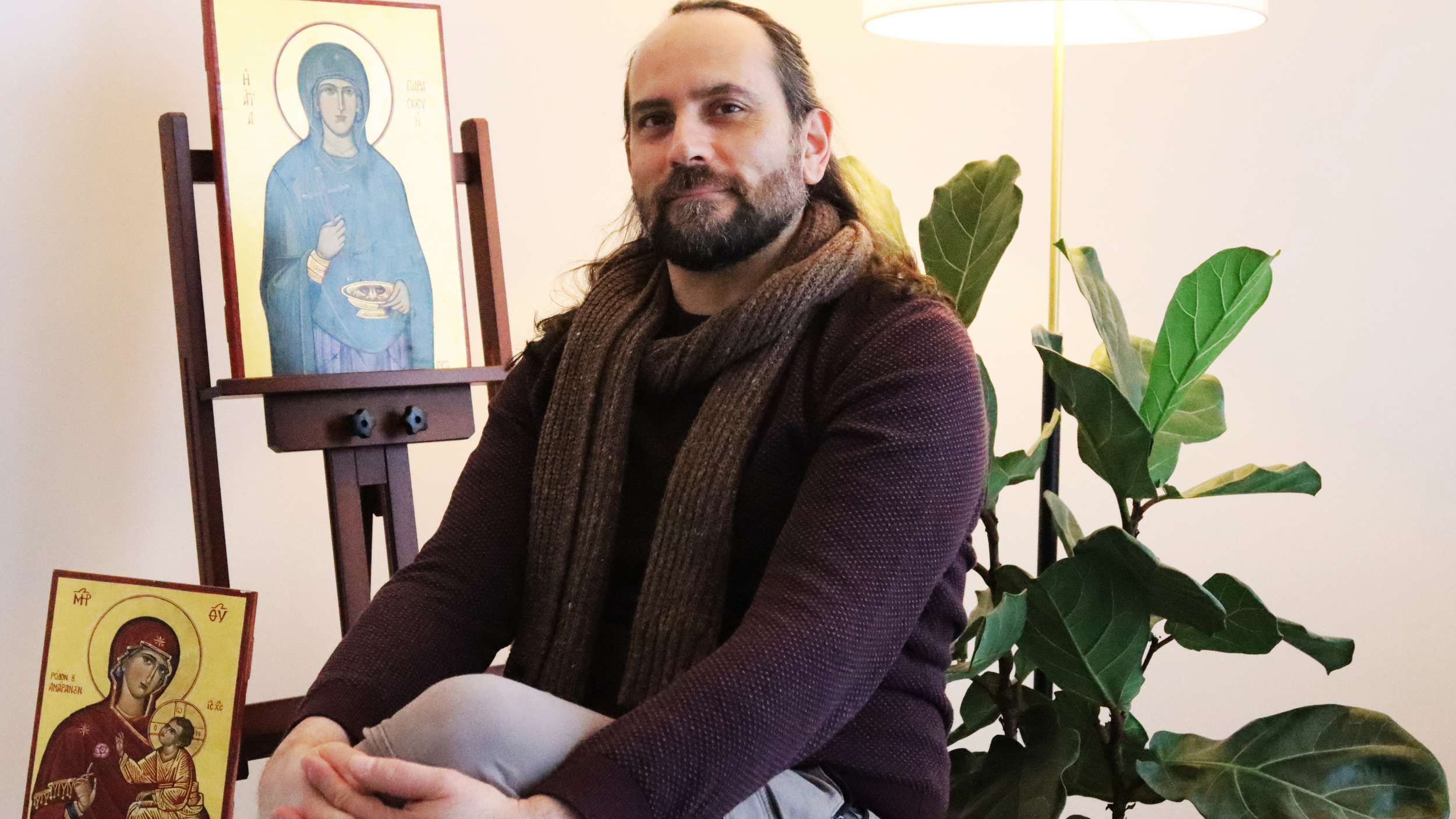
Apostolos Lagoutatzis. Photos: Supplied
For centuries, Byzantine iconography has been far more than a form of religious painting. It is a visual language shaped by theology, worship and tradition, passed from one generation to the next through careful observation, practice and faith.
Now, that tradition will take centre stage at Melbourne’s Hellenic Museum, where iconographer Apostolos Lagoutatzis will invite a new audience to discover not only how an icon is created, but why it is created in a particular way.
With more than 15 years of experience in Byzantine iconography, Lagoutatzis will lead Writing the Divine: An Introduction to Byzantine Iconography, an eight-week program designed specifically for beginners.
Beginning on 10 October 2026, the course will guide participants through the creation of an icon of the Virgin Mary from beginning to end, while exploring the history, symbolism and theology underpinning one of the Orthodox Church’s most significant artistic traditions.
The initiative accompanies the Hellenic Museum’s major exhibition, Divine Thresholds: Icons and the Orthodox Christian World, which explores the spiritual, historical and cultural significance of Orthodox icons and will remain on display until the end of August 2027.
A life devoted to iconography
For Lagoutatzis, iconography has never been simply an artistic pursuit.
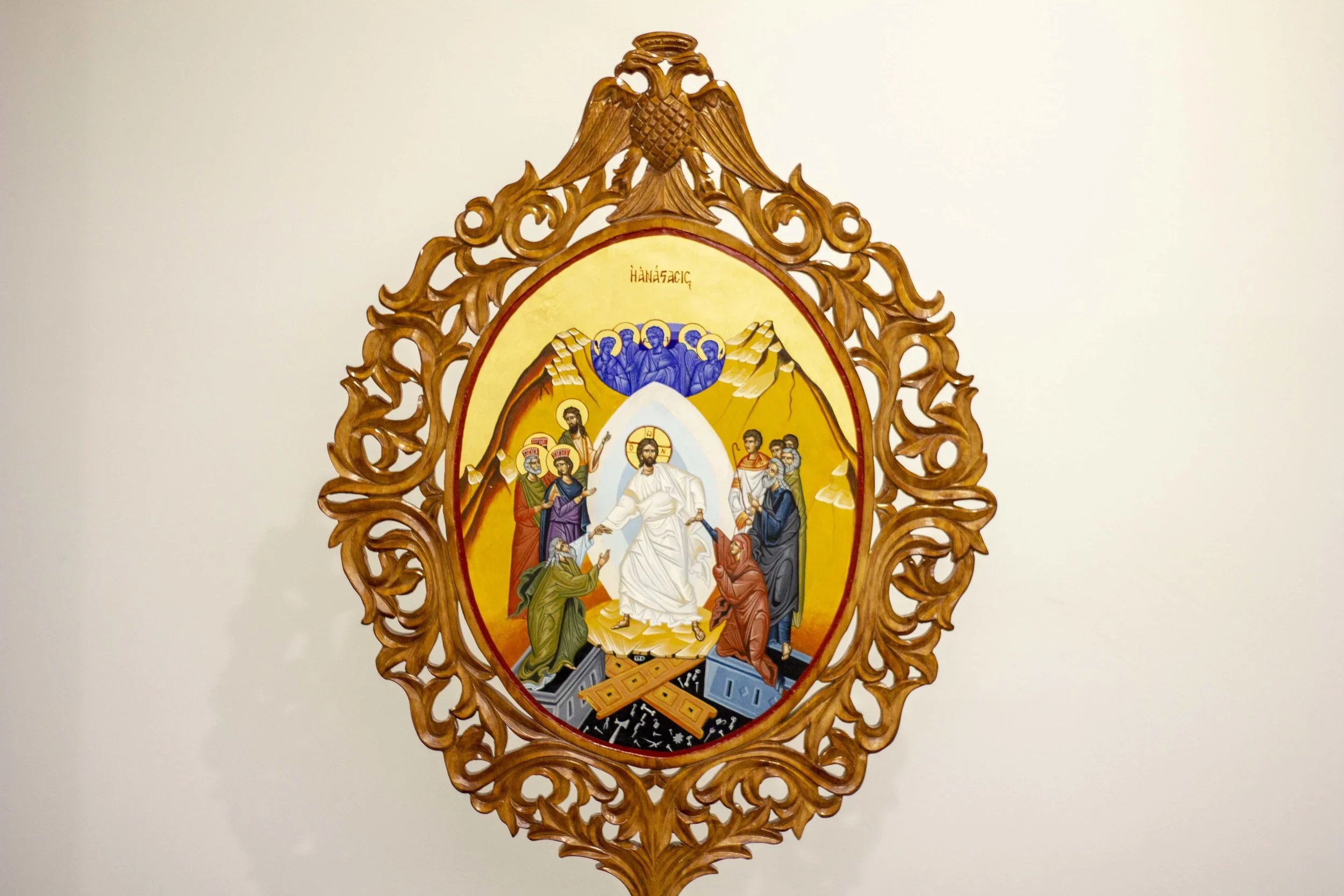
For more than 15 years, he has created icons for Orthodox churches, communities and private collections in Australia and overseas, while continuing his work through his own studio, Ikon Atelier.
Among his early ecclesiastical commissions was an icon for the Church of the Transfiguration of Our Lord in Thomastown, commissioned by then Father Evmenios, now a bishop of the Greek Orthodox Archdiocese of Australia.
Another followed for Melbourne’s historic Church of the Annunciation of Our Lady in East Melbourne, commissioned by Archimandrite Father Kosmas Damianidis.
As commissions from churches and communities increased, Lagoutatzis came to see his work as part of something much larger than his own artistic practice.
He sought the Church’s blessing to pursue his ministry as an iconographer, receiving the blessing of Metropolitan Isaiah of Denver and Bishop Iakovos of Miletoupolis, who played an important role in his spiritual and artistic development.
“This blessing has always been important to me. I understand iconography not simply as an artistic activity, but as a sacred tradition that belongs to the life and theology of the Orthodox Church,” Lagoutatzis said.
From icons to Byzantine music
His immersion in Byzantine tradition eventually extended beyond the visual arts.
In 2015, Lagoutatzis began studying Byzantine ecclesiastical music at the Church of St Eustathios in South Melbourne under teacher Lambros Vlahantonis.
Although expressed through entirely different forms, he sees Byzantine music and iconography as sharing a fundamental principle: both are inherited traditions requiring the student to listen, observe, study and understand before attempting to pass them on.
Lagoutatzis later completed theological studies at St Andrew’s Greek Orthodox Theological College in Sydney, further developing his understanding of the theological foundations behind his iconographic work.
A relationship with the Hellenic Museum
It was Byzantine music, in fact, that first connected Lagoutatzis with the Hellenic Museum.
In April 2023, his wife, Ioanna Nikoloulea, organised the concert Between East and West at the museum, bringing the Byzantine musical tradition before a Melbourne audience.
That collaboration gradually developed into a broader relationship encompassing music, iconography and the presentation of Orthodox cultural heritage.
For Divine Thresholds, the museum commissioned Lagoutatzis to create a film documenting the complete process of producing an icon of Christ.
Produced by Nikoloulea, the film follows the painstaking process from preparing the wooden panel and its surface through to drawing, gilding, applying colour and adding the final details.
Rather than seeing only a completed icon, museum visitors are given an insight into the patience, discipline and method involved in creating one.
That relationship took on another dimension when Divine Thresholds opened on 29 August, with Lagoutatzis performing Byzantine hymns alongside his wife and daughter.
Music and visual art came together, presenting Orthodox heritage not as something confined to history, but as a living tradition that continues to form part of contemporary Greek and Orthodox identity.
‘Writing the Divine’
Teaching iconography, Lagoutatzis says, is something he has wanted to do for years.
“One of the questions I have been asked most often over the years is: ‘Can you teach me iconography?’ It has always been a dream of mine to create a program through which I could share this beautiful tradition with others,” he said.
“After years of preparation, I am very happy that it is finally becoming a reality.”
Over eight weeks, students will create an icon of the Virgin Mary, gradually learning the traditional materials and techniques used by iconographers.
They will prepare the surface and work with gold leaf, pigments and egg tempera before learning how to construct garments and facial features, moving from the darkest tones towards light.
The final stages will introduce highlights, inscriptions and finishing details.
Classes will be kept small, allowing Lagoutatzis to work closely with each participant. No previous iconography experience is required and all materials are provided.

Learning not only how, but why
Technique, however, is only one part of the course.
Participants will also explore the history, theology and symbolism behind Byzantine iconography.
They will learn why light emerges through successive layers, what colours and gestures signify, and why perspective and the depiction of the human form differ so markedly from conventional Western painting.
For Lagoutatzis, understanding those choices is essential to understanding what an icon actually is.
“We are not simply learning how to paint an icon,” he said.
“We are learning how to read it and, ultimately, how to speak its language through the work of our own hands.”
The course has been years in the making. Every stage in the creation of the study icon has been methodically documented, while participants will receive a 70-page manual containing detailed instructions, traditional recipes and visual guides.
Recorded demonstrations will complement the manual, allowing students to revisit techniques and continue studying the process after the classes have finished.
The objective is not simply to leave with a completed icon, but with the foundations to understand the tradition from which it emerged.
Passing the tradition forward
For Lagoutatzis, returning to the Hellenic Museum as a teacher marks a new chapter.
After more than 15 years spent working at the icon board, he is now preparing to pass on knowledge accumulated through apprenticeship, church life and personal study.
The progression from Byzantine music to iconography, and from practising the art himself to teaching others, is bound together by the same principle: preserving a tradition by ensuring it continues to be transmitted.
“It is a great joy for me to finally be able to offer this program,” Lagoutatzis said.
“With God’s help, I hope to pass something of this beautiful tradition on to others. I look forward to writing icons together.”
Writing the Divine: An Introduction to Byzantine Iconography begins on 10 October 2026 at the Hellenic Museum in Melbourne. The eight-week course is limited to a small group, requires no previous experience and costs $1,400 per person, including all materials. Information and registrations are available through the Hellenic Museum.